How to Get Your First 10 Local Web Design Clients

How to Get Your First 10 Local Web Design Clients
Introduction
# How to Get Your First 10 Local Web Design Clients Without Referrals, Ads, or an Audience
Most web designers don’t fail to get clients.
They get a few, by accident.
A friend needs a site. A referral shows up. Someone finds them once and disappears.
It feels like momentum—until it stops.
That’s when panic sets in. Portfolios get redesigned. Logos get tweaked. Posts go out daily. Everyone waits for “visibility” to do the work.
This isn’t a talent problem. It’s a system gap.
The first 10 web design clients don’t come from scale tactics. They come from controlled, repeatable actions you can run without traffic, referrals, or ad spend.
This guide breaks down the exact system I’d use to land my first 10 local web design clients starting from zero.
Manual. Finite. Predictable.
---

The first 10 web design clients don’t come from scale tactics. They come from controlled, repeatable actions you can run without traffic, referrals, or ad spend.
Why Most Web Designers Stall After Client #2 or #3
Early wins usually come from luck, not leverage.
- A friend of a friend
- A local business that “knows a guy”
- One inbound message that never repeats
The issue isn’t referrals themselves. It’s that they don’t teach you how clients are acquired.
What’s missing underneath:
- No defined audience
- No repeatable acquisition step
- No inputs you control
So when referrals slow down, there’s nothing to replace them.
Designers respond by waiting—or by chasing exposure instead of installing a process.
The fix isn’t more visibility. It’s switching from hope-based acquisition to process-based acquisition.
---
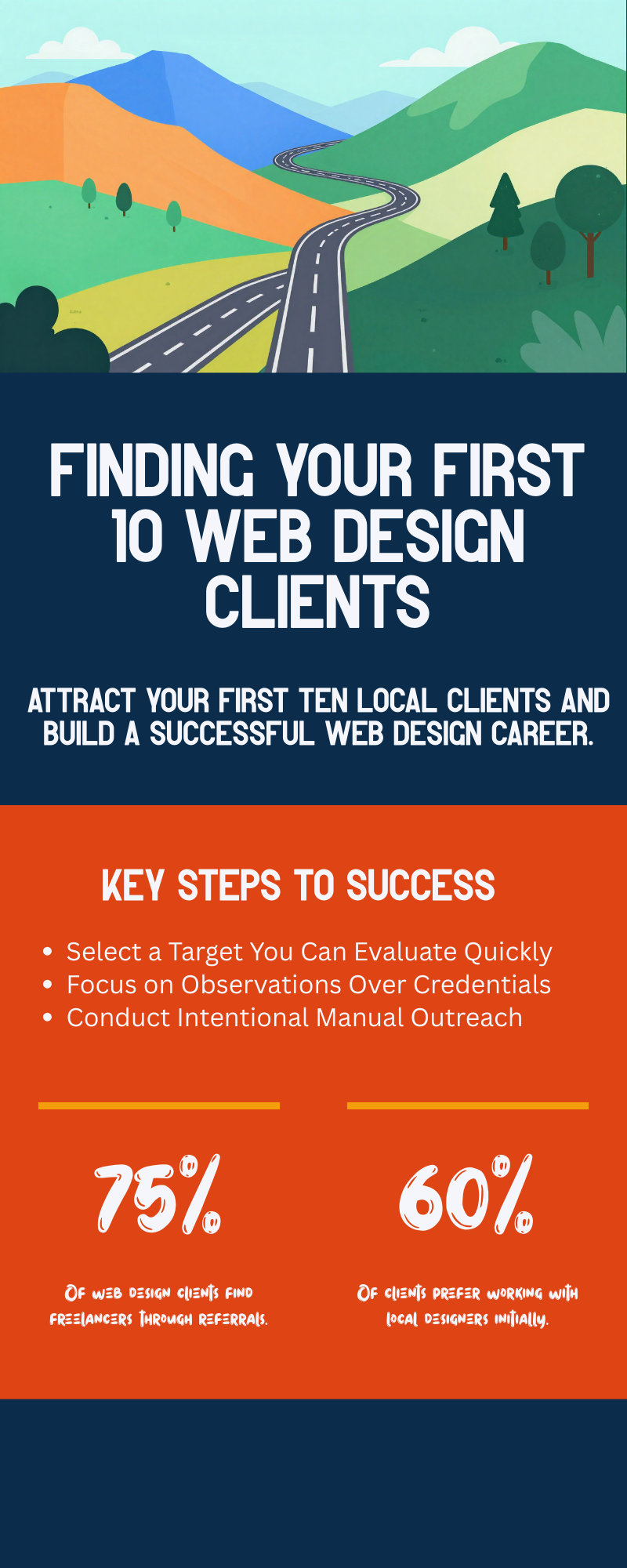
Understanding the Unique Rules for First 10 Clients
Most beginners copy tactics from people who already have leverage.
SEO. Content. Personal brands. Funnels. Ads.
All of those work after you have proof, positioning, and cash flow. Before that, they’re slow and unforgiving.
Your first 10 clients live in the unscalable phase.

Different rules apply:
- Speed beats reach
- Precision beats volume
- Manual beats automated
Your goal here isn’t growth.
It’s evidence.
Evidence that:
- A specific type of business will respond
- They recognize the problems you point out
- They will pay you to fix them
---
The Proven System for Early Web Design Success
No funnels. No hacks. No content calendar.
Just three steps you can run every week until the math works.
---
Step 1: Select a Target You Can Evaluate Quickly
“Small businesses” isn’t a market. Neither is “anyone who needs a website.”
Vague targeting forces you to sell. Specific targeting lets you observe.
Your target must lock together:
- One business type
- One location
- One visible problem
If you can’t tell within 30 seconds whether a business qualifies, your scope is too broad.
---
Step 2: Focus on Observations Over Credentials
Local businesses don’t hire web designers because of credentials.
They hire when you point out a real problem they can’t unsee.
Examples:
- “Your site doesn’t load correctly on mobile”
- “Your contact form errors on Safari”
- “Google can’t index your services page”
These aren’t pitches. They’re observations.
---
Local businesses don’t hire web designers because of credentials. They hire when you point out a real problem they can’t unsee.
Step 3: Conduct Intentional Manual Outreach
You don’t need scale. You need replies.
Rules that work:
- One channel at a time
- 10–20 messages per day
- No pitching on first contact
Your goal is to start conversations.
---
Your only goal is replies.
A Realistic Example of Your First Week in Web Design
Abstract systems feel good. Seeing the system run removes doubt.
Here’s what this looks like if you start from zero.
Day 1: Secure Your Target Client
- Choose one business type (e.g. local contractors)
- Choose one city
- Decide on one visible problem (slow mobile sites)
No research rabbit holes. You’re committing for one week, not forever.

---
Day 2: Create a Targeted Prospect List
- Google businesses in that niche + city
- Open each site on your phone
- Flag obvious issues (speed, broken forms, cluttered contact pages)
Stop at 30 prospects. More than that is unnecessary.
---
Steps to Create a Targeted Prospect List
- Google businesses in niche + city: Identify local businesses that fit your criteria.
- Open each site on your phone: Check mobile performance and usability.
- Flag obvious issues: Note down issues like slow loading or broken forms.
Days 3–5: Share Observations Instead of Pitches
Each day:
- Send 10 short messages
- One issue per message
- No selling
Example: > “Quick note — your site loads slowly on mobile. > On my phone it took ~6 seconds. > Is that something you’ve noticed?”
Your only goal is replies.
---
Day 6: Analyze Client Signals
By now, you’ll know:
- Which problems get responses
- Which wording feels natural
- Whether the niche reacts at all
This is progress—even without a sale.
---
Day 7: Present Your First Offer
Only after conversations start:
- Offer a small, contained fix
- Clear outcome
- Fast turnaround
Not a redesign. A win.
---
Deciding Your Next Steps After One Week
Did you get responses from potential clients?
Yes → Continue engaging with those clients and refine your approach.
No → Reassess your target and outreach strategy.
What Your First Week Proves About Web Design
After seven days, you’ll have answers to questions most beginners never test:
- Will this niche talk to me?
- Do they recognize the problem?
- Will they pay to fix it?
That’s momentum.
Not from hope. From controlled inputs.
What to Offer Before You Have Case Studies
You don’t need full redesigns.
You need contained wins:
- Homepage cleanup
- Mobile speed fixes
- Contact flow improvements
These are proof generators.
---
You need contained wins: Homepage cleanup, mobile speed fixes, contact flow improvements. These are proof generators.
Common Mistakes That Hinder Early Outreach Success
- Targeting too broadly
- Pitching before pointing out problems
- High volume with no feedback loop
- Waiting to feel “ready”
---
How Long It Takes to Implement the System
Typical input math:
- 10–20 messages per day
- 1–2 clients per month
Predictable. Boring. Effective.
---
Typical Input Timeline for Client Acquisition
- Day 1: Secure Target Client: Choose business type, city, and problem.
- Day 2: Create Prospect List: Identify local businesses.
- Days 3-5: Share Observations: Engage with prospects.
- Day 6: Analyze Signals: Assess client reactions.
- Day 7: Present Offer: Make your first proposal.
The True Advantage of Effective Web Design Strategies
This system works manually.
Once it works, your next problem isn’t strategy. It’s coordination.
The system is the advantage.